The Zimbabwe Chamber of Informal Economy Associations
ZCIEA is a National Membership driven Organization representing Informal Traders Associations of Zimbabwe. It is made up of the self employed and informal employees
engaged in small unregistered or un-incorporated enterprises and undeclared workers.
THE VISION
Decent standards of living for all Zimbabweans in a stable economy.
THE MISSION
Alleviating poverty through transforming informal economy activities into mainstream activities.
ZCIEA SLOGAN
“ The Chamber That Delivers”
Objectives
To organize, establish, promote and protect the interest of the informal economy traders in Zimbabwe.
To foster for democratization of the environment through rights awareness, lobby and advocacy programmes targeting the rank and file of the Informal Economy Workers.
To capacitate ZCIEA structures in a manner that enables them to engage authorities at all levels and demand accountability whilst operating proficiently.
To influence policy formations which will bring about social and economic change whilst providing for the transformation of the Informal Economy activities in Zimbabwe and beyond.
Our History
The organization was founded in 2002 by a group of 22 Informal Traders Associations who desired to have an Apex body for this massive 84% of the Zimbabwean Economy which paradoxically had a weak voice, vulnerable to harassments, political abuse , no income security and lack of social protection.
This was a direct response to the collapse of formal setups as a result of Economic Structural Adjustment programme (ESAP) which was introduces by the Zimbabwean government in the 1990s. The company closures, retrenchments and the inability of formal structures to absorb the job seekers gave rise to massive expansion of the informal economy.
On seeing the continued marginalization of this sector, formation of this Apex body was a result of a tripartite decision by ZCTU (Labour) EMCOZ (Business) and Ministry of Labour (Government).
The objective was to harness these precarious operations and seek means and strategies that will facilitate mainstreaming of the Informal Economy with a view to empowering it socially and economically.
Informal economy workers and traders are still being criminalized in Zimbabwe and this led to high incidents of brutal evictions of vendors from their workplaces, arrests, and confiscation of goods by Zimbabwe Republic Police and Municipal Police.
ZCIEA received a report from members in the Rusape Territory that the Zimbabwe Republic Police started arresting vendors in Rusape Town on the 22nd of October 2020. 76 vendors were arrested on the 22nd of October 2020. According to our members in Rusape Territory, ZRP officers stated that they were instructed by their superiors to arrest vendors because they are too many and selling at undesignated points. Local authorities used the veil provided by the lockdown to demolish vending stalls/informal structures throughout the country, Rusape included, and this resulted in vendors/informal traders incurring huge losses since their source of living was destroyed. Vendors who were arrested were charged a fine of RTGs 1000 cash, and ZRP officers were said to be rejecting swipe or EcoCash. 18 vendors were arrested on Friday the 23RD of October 2020, and Member of Parliament Honorable Tekeshe secured their release. On Sunday 24th of October 2020, 11 vendors were arrested bringing a total of 105 vendors arrested by ZRP in Rusape since Thursday the 22nd of October 2020. ZCIEA members were part of the vendors who were arrested in Rusape, the majority of whom were women. Some were released after paying RTGs 1000,00. Vendors questioned why they were being arrested and the response was that vendors should operate from designated points at Markets. Vendors argued that markets were demolished during lockdown to pave way for renovations and up to now nothing has been done in terms of providing a decent working environment (Market) for vendors. ZRP Rusape is said to be acting on information that Rusape Town Council received money to construct markets for vendors, therefore any vendor caught selling at an undesignated point should be arrested. The reality of the ground according to vendors in Rusape is that the council is yet to construct the market for vendors instead vendors are being asked by the Local Authority to contribute USD 50,00 per head towards the construction of the market which is beyond the reach of many vendors who live from hand to mouth.
The Informal Economy is a key player in resuscitating the economy of Zimbabwe, so all authorities must be educated to value the Informal Economy work and stop criminalising them. As the Minister of Women’s Affairs, Community, Small and Medium Enterprises Development, Dr Sithembiso Nyoni said in her speech in Bulawayo at the unveiling of new vending warehouse, “This sector has been key in Zimbabwean economy”
As Zimbabwe Chamber of Informal Economy Associations, we urge Zimbabwe Republic Police and Local authorities to engage informal economy players/ vendors before making a decision that affects their livelihoods. Street vendors and informal economy workers are willing to work in cooperation and solidarity in maintaining clean cities and the environment. Cities and towns should prioritize citizens’ dignity and right to livelihoods over profits. Right to the City is not about destroying livelihoods for public health but rather working together for the health and safety for all. Street vendors and informal economy workers can be agents of good public health. Authorities must work with them, not against them. We are, therefore, sending our National leadership team to go and have engagement with the authorities to address the situation on the ground. Informal traders are busy working to try and raise school fees for their children to go back to school. We urge our government to give reprieve for these vulnerable citizens so that they become meaningful components of their families and communities.
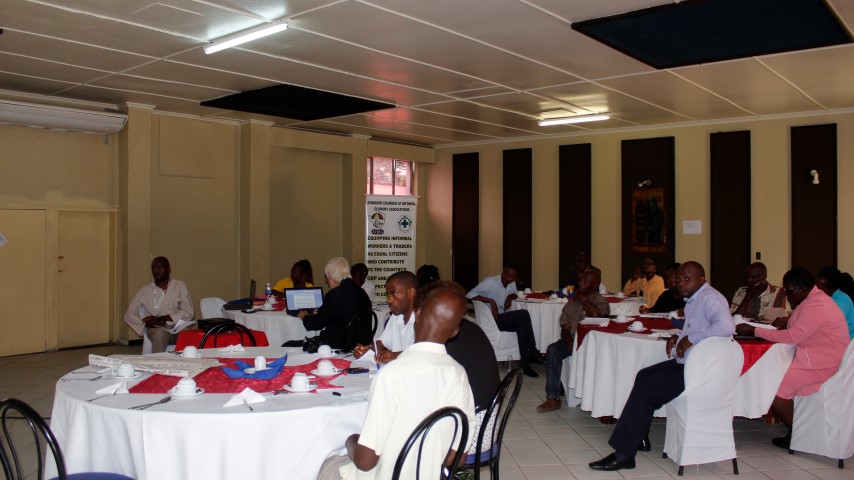
Zimbabwe Chamber of Infomal Economy Associations conducted Stakeholders Engagement Meeting in Masvingo Territory on Formalisation of the informal Economy on the 14th January 2020. ZCIEA was represented by National President Lorraine Sibanda, SG Wisborn Malaya, Masvingo Territorial Committee led by President Tavengwa Mazhambe, Masvingo PWD Chair Moses Chitombo and Information officer Fungai Munetsi. The other Stakeholders who attended the meeting included representatives from Masvingo City Council, ZIMRA, Hevoi fm, freelance journalists, Councilors, Zimbabwe Council of churches, Masvingo United Residents and Ratepayers Association. Mark Oxley represented Centre for International Private Enterprise (CIPE). The meeting was facilitated by Secretary General Wisborn Malaya who gave a background of Zimbabwe Chamber of Informal Economy Associations (ZCIEA). ZCIEA National President Lorraine Sibanda gave a presentation on 7 key thematic areas of the informal Economy Agenda which speaks or supports the Formalisation of the informal economy. The 7 key thematic areas for the Informal Economy Agenda are as follows: 1. Respect for and recognition of the informal economy Objective: – To create an improved legal policy framework that recognizes and addresses the reality of the informal economy and those working in it. 2. Development of linkages between Informal Economy and Formal Businesses Objective:- To develop a conducive business operating environment for the informal economy businesses and workers 3. Market access and infrastructure Objective:- to establish secure market spaces and infrastructure for Informal Economy Businesses in both rural and urban areas -to enable informal economy workers to access broader and profitable markets for their goods and services. 4. Formalisation Objective: to provide access to economic freedom and social protection to Informal Economy businesses in order to provide sustainable jobs and income for Informal Economy workers. 5. Financial Inclusion Objective: to improve the level of provision of financial services to informal economy businesses 6. Social Protection Objective:- to provide affordable services in the form of pensions, medical aid and insurance to Informal Economy businesses people & workers 7. Devolution Objective:- to empower local communities through decentralization of state administration and authority.
ZCIEA Secretary General encouraged Zimbabwe Revenue Authority (ZIMRA) to promote formalization strategy of the informal economy as a key driver to boost revenue collection for the country. This will have to be supported by tax incentives under financial inclusion. ZCIEA is also pushing for partnerships with Local Authorities throughout the country in order to promote decent operational and living standards for better livelihoods.
Zimbabwe Chamber of Informal Economy Associations (ZCIEA) is a National Membership driven organisations representing workers and traders in the informal economy throughout Zimbabwe. ZCIEA has 43 Territories in urban and rural areas with Gutu Territory being one of the Territories.
Gutu is the third largest district in Masvingo Province, southern Zimbabwe, after Chiredzi and Mwenezi. It is the northernmost district in the province. The name “Gutu” is historically reported to have emerged from “Chinomukutu wemiseve” – meaning, “the one with a load of arrows.
Six members of the ZCIEA Gutu territory youth structure joined together and started a farming project producing tomatoes, potatoes, and sugar beans. The group is led by Amos Masunda. Amongst the six are three men and three women based in Masunda village in Gutu Mupandawana near Chinyika Township.
They started their project in June 2018 with only 2000 plants of tomatoes, 400 plant potatoes, and half-acre sugar cane. Their income-generating project is helping them to earn a living though they are supplying their products to the local area in small scales.
Gutu youth through their project proved that success comes through handwork. Despite the economic meltdown in our country including the high cost of producing green crops, they continue with their business even though it is producing a small profit.
Some of the key challenges they are facing include; unstable prices where they purchase seeds and chemicals. Some seeds are not properly treated. The market is too far 35 km from where they operating from. Do not have modernized irrigation equipment so they are using manual methods of irrigation which are time consuming and tiresome.
They aim to grow their business and supply all the areas in Gutu with their produces. The group is appealing for assistance with water pump either diesel or solar pump, pipes, knapsack sprayer, chemicals and seeds in order to boost their project. The group through ZCIEA Gutu Territorial leadership is engaging the Gutu Rural District Council to have Memorandum of Understanding between ZCIEA and the Council. They are also requesting the Council to allocate trading space for informal economy traders and construct market at Chinyika Township.
Zimbabwe Chamber of Informal Economy Associations (ZCIEA) People With Disability Chair for Kwekwe Territory Hlahla Ncube joined ZCIEA in 2015. He started the Poultry farming business in 2008 and he is looking after four members of the family from that business.
Zimbabwe’s disabled people are usually the last to be hired and as a result, most of them resort to begging and vending selling items such as cell phones, airtime, sweets, clothes, watches, and fruit from the pavements, competing with able-bodied fellow vendors.
“As People With Disabilities operating in the informal economy, we face a lot of challenges and barriers daily in our society. People with disabilities in Zimbabwe are marginalized and treated as if they are not capable of functioning on their own. Disability is equated with inability. People With Disability surviving through trading in the informal economy face harassment and criminalization, at times their goods confiscated by local authorities,” said Mr. Ncube.
He also mentioned that one of the prominent challenges involves disabled vendors being made to pay extra fees by the City Council Authorities for double slots or bays mainly because their wheelchairs cannot fit within the small vending stalls or bays allotted individually.
We face discrimination in the transport sector, motorists or commuter omnibus conductors are reluctant to accommodate Person With Disability (with a wheelchair). People With Disabilities are excluded in terms of accessing loans, access trading space as compared to able-bodied persons. Most buildings are not accessible to person on a wheelchair, therefore disability friendly structures will ease accesibility challenges.
“ZCIEA has empowered me through education and training on the rights of People With Disabilities and constitution, negotiation skills training, improve your business training, and networking with other PWD members throughout Zimbabwe. After joining ZCIEA, the organization has equipped me to effectively educate and recruit other People With Disability to work for themselves, defend or fight for their rights,” said Mr. Ncube.
“As ZCIEA PWD Chair for Kwekwe Territory I urge our Zimbabwean Government to include People With Disabilities when rolling out National Youth Empowerment programs, ” said Mr. Ncube.Share
an interview by Franz Schmidjell (Vienna Institute for International Dialogue Cooperation)
Lorraine Sibanda from Zimbabwe talks about her engagement for women in the informal economy. Nearly all of Zimbabwe’s labour force works informally, meaning that their income generation is not regulated by the state, and the majority are women. These women often face poor working conditions, harassment and criminalisation. But there are success stories, too. Lorraine Sibanda will speak at the panel discussion Silenced? Women’s struggles in Africa’s informal economy on 7 October 2019 in Vienna.
Franz Schmidjell: How did your personal involvement in the struggle for women in the informal economy start?
Lorraine Sibanda: I grew up in an informal economy-supported home. My mother was a multi- talented, industrious trader, tailor, florist, baker and craftsperson. My father was a skilled, self- employed bricklayer of note. For me, informal economy issues are lived realities.
As a teacher, I supplemented my salary by buying and selling different commodities, tailoring and home decor. In 2007, I started voluntary work with the Women’s Coalition of Zimbabwe as the Gwanda Chapter Chairperson until 2016. I worked with women from different backgrounds and learnt a lot about women and human rights issues. Many women were struggling to make a living under harsh economic conditions. On a personal level, I shared skills, ideas and resources to support other women with livelihood projects, no matter how small. I also worked with women on constitutional literacy to help them understand and utilise the national constitution to claim their rights. In 2015, I was elected ZCIEA National President for a five years term, from 2015 to 2020.
Franz Schmidjell: How does your typical work day look like?
Lorraine Sibanda: The organisational business of both the Zimbabwe Chamber of Informal Economy Associations (ZCIEA) and StreetNet International involves a lot of consultations on different processes and programs, decision-making, interface with members and partners, and chair meetings. On topical issues, I have to draft and issue statements. Besides organisational business, I have to attend to my family’s needs, perform house chores, maintain my livelihood projects which include goat farming, buying and selling different commodities and tailoring. The work that I do for both ZCIEA and StreetNet International is voluntary and has no salary perks or benefits.
Lorraine Sibanda: The ILO Recommendation 204 says that the informal economy is in law or practice not covered or insufficiently covered by any formal arrangements. The informal economy refers to all income generating activities that are not regulated by the state. Local authority by-laws are archaic, outdated and irrelevant to the current informal economy levels in Zimbabwe. The economy is characterized by small-scale operations, the inadequacy or absence of social protection, huge decent work deficits and harassment, and criminalisation by law enforcement agents. I want to emphasize that most workers do not enter the informal economy by free choice but are forced to do so because of a lack of job opportunities or retrenchment. The informal economy offers a means of survival. According to the Labour Force Survey of 2014, 94.5% of the Zimbabwean working population is in the informal economy. More than 65% of informal economy workers are women. The main sectors are general trading, cross-border trading, vending, carpentry and welding, farming, transport and services which include hairdressing.
Women are more affected by informal economy working conditions. They have no maternity cover or benefits, so they work through their terms of pregnancy and take their newborns to work with them. Women with children have difficulties to access affordable childcare facilities. They have the extra burden of caring for and ensuring the safety of their children as they play their trade in public spaces. This exposes children to high levels of vulnerability and abuse, and women are affected by violence and harassment.
Franz Schmidjell: How does ZCIEA react to the needs of female workers? Have local struggles been successful?
Lorraine Sibanda: ZCIEA coordinated women members from Chitungwiza territory to set up “Savings and Credit Cooperative Societies” (SACCO). The objectives of these SACCOs were to 1) support each other socially, 2) to use SACCOs as affordable loan facilities so that members could boost their businesses and 3) to empower each other. Different small-scale business groups with 10 to 60 members each were established, like tailoring and fashion designing, peanut and sunshine butter making, fish drying, mushroom production and family food service. In 2015, ZCIEA Chitungwiza territory was given permission to use a community hall, the garment factory. All Sacco groups operated from the garment factory. In 2016, the Ministry of Small to Medium Enterprise took over the garment factory, saying that the Ministry wanted to use it as a training centre for tailors. The SACCO groups were left stranded without a conducive operation space. However, the groups continued with their savings and credit schemes. The same members, with the assistance of the ZCIEA office, successfully challenged the eviction of traders from the Njambanja market early in 2019. They have since engaged with the local authority and have secured permission to build a modern market on the market site. ZCIEA is working to assist these members to mobilise resources and funds to commence the construction of the market.
Franz Schmidjell: You are also President of StreetNet International, a global alliance of street vendors. Why did the last StreetNet International Congress in April 2019 focus on the Elimination of Violence and harassment in the world of work?
Lorraine Sibanda: The issue of violence and harassment against informal economy workers, particularly street vendors and informal traders, is a daily phenomenon. StreetNet International had to develop a strategy and position to meaningfully contribute to the available International Labour Conference sessions on the topic.
Street vendors suffer physical, moral and sexual violence and harassment, including brutal evictions from their workplaces which are public spaces and the streets. Confiscation of goods, arrest, multiple and burdensome taxes and levies, extortion or bribes impact negatively on the opportunity to work. Informal economy workers also have to contend with planned fires on markets, “ beautification” policies of local governments which do not contain alternatives for the street and market vendors. Furthermore they have to cope with persecutions by the police and local authorities as well as lack of proper sanitation and daycare centres.
The vulnerability of women informal economy workers in public spaces, their workplaces, needs to be addressed. Measures of effective protection need to be worked out!
Franz Schmidjell: The ILO is celebrating its 100 years anniversary these days. Does the labour organisation address your issues?
Lorraine Sibanda: There is an ILO Convention on this topic. The June 2019 International Labour Conference developed and adopted Convention 190, supplemented by Recommendation 205 on the Elimination of Violence and Harassment in the world of work. It now applies to all workers, including workers in the informal economy. However, a strategy to campaign for the ratification of the Convention at national level needs to be developed first. StreetNet International is already working on the strategy. Africa is also experiencing xenophobic attacks which bring a lot of violence that affects crossborder traders and immigrant workers. There is a desperate need for governments to revise their approaches and to develop and take decisive moral action as an immediate intervention.
Franz Schmidjell: What does international solidarity mean in this context?
Lorraine Sibanda: International solidarity is always effective and influential towards any global issues and challenges. StreetNet International is committed to any progressive joint efforts, actions and campaigns which are in compliance with StreetNet International’s values, goals and members’ concerns.About Lorraine Sibanda
Zimbabwe Chamber of Informal Economy Associations (ZCIEA) Chipinge Territorial Acting President Dennis Maluwa who is also a youth member joined ZCIEA 5 years ago and has been an active member since then. He benefited from ZCIEA in many ways through training which helped him to be a strong young man who can work on his own and become influential in the community where comes from.
Dennis Maluwa is proud and feels honored to be a member of ZCIEA. He is also a beneficiary of the ZCIEA revolving fund program, collective negotiation skills training, improve your business training (IYB), voter education, and constitutional rights awareness program, etc. “ZCIEA has helped me in many ways such as social networking, being influential, right awareness programs, entrepreneurship skills, I.T, voters rights awareness, to mention but a few”, said Mr. Maluwa.
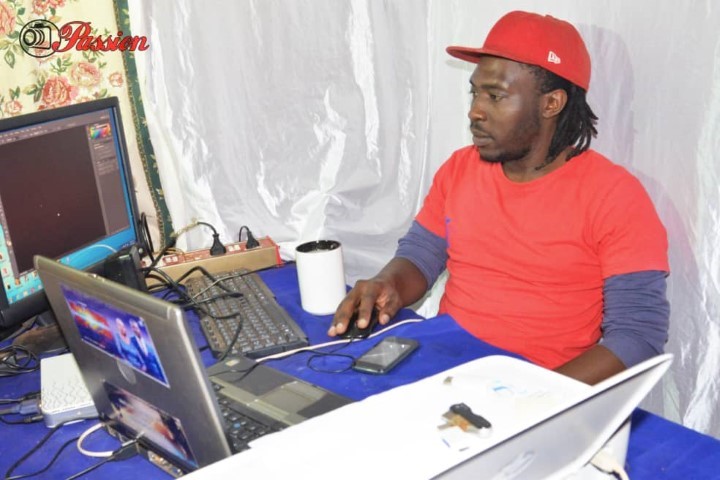
Dennis Maluwa has a vibrant project called “Passion Arts”. He does photography, video production and he also a producer. He started his business in 2017 and has produced more than 10 music videos which are trending in Chipinge and countless wedding videos. Passion Arts Company is still growing and it’s indeed helping him to earn a living.
With the help from ZCIEA, Dennis Maluwa attended the Youth Connekt Start-up Tour Bus program for entrepreneurs and innovators between the ages of 18 – 35 at Mutare teachers college from the 18 to 19 July 2019. The program was aimed at training young entrepreneurs on how to pitch a business. “We were also trained on how to be innovative and creative as a youth to target major business propositions which can benefit the community at large and which are convincing enough to be supported, said Mr. Maluwa”. I want to thank the national office for allowing this chance.
Mr. Maluwa encouraged all the youth to work for themselves and stop complaining about the economy without doing anything about it. “I would like to challenge all the young people complaining and doing nothing, get up and fight for yourselves. Let’s stand up and prove ourselves worthy leaders of tomorrow. I believe in every seed there is an opportunity to grow, we reap what we sow, sow seeds of potential, endurance and most importantly focus. The journey of a thousand miles begins with one single step”
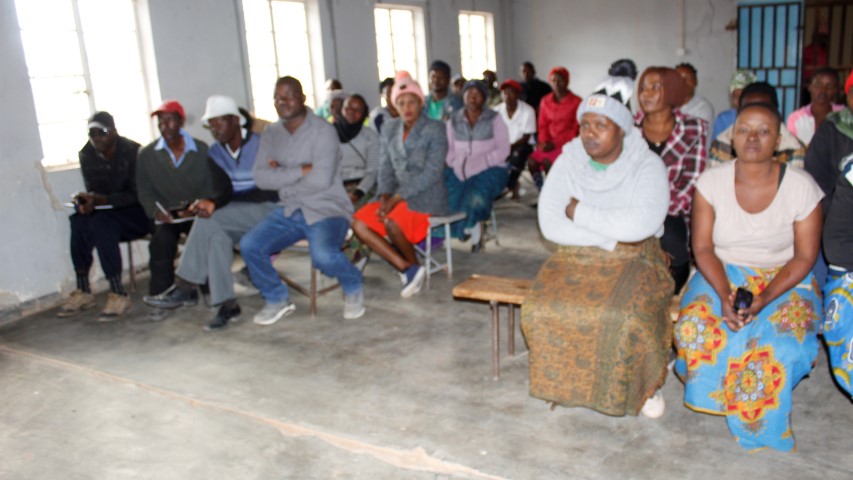
On the 21st of June 2019 Zimbabwe Chamber of Informal Economy Associations “ZCIEA” sets up a new territory in Zhombe. Zhombe is a rural communal area between Gokwe and Kwekwe District, Midlands province in Zimbabwe. The program was conducted by ZCIEA 2nd Vice National President Stella Chivandikwa, Treasurer General Givas Maririmba with the assistance of the information officer Fungai Munetsi.
The informal economy traders in Zhombe Territory consists of vendors selling agricultural produce, second hand and new clothes, and a few traders selling imported products like cooking oil, detergents etc. The informal economy has become highly invaded by multi skilled players who are even shifting their carrier skills to anyhow trading as a way to at least earn a living. Survival strategy based work is the torch for the hopeless and down trodden men and women.
A total of 57 informal traders (members) voted for Zhombe Territorial leadership which is made up of territorial main committee, youth committee, women’s committee and People with Disability (PWD) committee. The main committee is comprised of Territorial President, Vice President, Secretary Vice Secretary, Treasurer, Organizer, Vice Organizer, and three committee members. The Youth committee consist of Youth Chairperson, Vice Chairperson, Secretary, Vice Secretary, Organiser, Vice Organiser, Treasurer, and three committee members.
A total of 41 informal economy traders joined the organization, women and youth were the majority. Zhombe territory will be one of the vibrant territory in the organization because of youth dominance in the territory.
ZCIEA National Women’s Chairperson Mrs. Mandishona represented ZCIEA at Women in mining workshop organized by Women and Law in Southern Africa (WLSA) on n the 19th of June 2019. The subject of the workshop was putting women at the centre of extractivism moving with the theme for 2019 international women’s day “#balance for better”.
Several topics were discussed such as: moving towards a gender-sensitive mining industry through the encouragement of female participation in mining projects in Zimbabwe; Analyzing the legal, institutional and policy constraints affecting the participation of men and women in the local context; Gold beneficiation, value edition for women in mining and development outcomes in the mining sector in Zimbabwe and the experience of women in artisanal gold mining.
ZCIEA noted the issues affecting women in the informal economy especially in the mining sector for example women are not included in mining ministries and decision making bodies, difficult for women to get a proper license due to high registration fees and abused sexually. They resolved that there is a need for inclusion of women in decision-making bodies, educating women in the mining sector about rights and gender equality.
On the 19th of June 2019 Zimbabwe Chamber of Informal Economy Associations “ZCIEA” sets up a new territory in Inyanga. The program was conducted by the 2nd Vice National president Stella Chivandikwa, 1 st Vice National Secretary General Sibongile Chakabva, Mutare Territorial president Mrs. Gonese with the assistance of the information officer Fungai Munetsi.
The elections were done and came up with the territorial main committee, youth, Woman and PWD structure. The main structure is comprised of Territorial President, Vice President, Secretary Vice Secretary, Treasurer, Organizer, Vice Organizer, and three committee members. The newly elected leadership were encouraged to work with their members in Inyanga, effective information dissemination to promote transparency in the territory.
Workers and traders in the informal economy are very much organised such that the bad and negative perception about them in Zimbabwe must stop for good. This should cleanse the old and outdated thinking of the city fathers who still harass and criminalise vendors and informal traders. Every Zimbabwean citizen has a role to play in the Zimbabwean economy. We are pushing for a space to be at the table in the TNF so that no Informal Economy transitional issues will be discussed without our presence. “The Chamber that Delivers”
Zimbabwe Chamber of Informal Economy Associations “ZCIEA” sets up a new territory in Mt Darwin on the 17th of June 2019.The program was conducted by the 2nd Vice National President Stella Chivandikwa, 1st Vice National Secretary General Sibongile Chakabva, Bindura Territorial president Mupasa, and Kean Makuwaza (Intern).
Territorial Elections were done and came up with the territorial main committee, youth, Woman and PWD structure. The main structure/committee has the following leadership positions: Territorial President, Vice President, Secretary Vice Secretary, Treasurer, Organizer, Vice Organizer, and three committee members (Territorial Women’s Chair- 1st Committee member, PWD Chair – 2nd Committee member & Youth Chair- 3rd Committee member.
ZCIEA is empowering informal traders all over Zimbabwe with skills to effectively negotiate for Memorandum of Understanding (MOUs) with their local authorities. The MOUs serves to keep a good relationship between informal traders and their local authorities. ZCIEA is indeed serving its mandate of promoting and protecting the rights and interests of informal traders.



 ZCIEANEWS